Fall Prevention Starts Here: The One Move Every Senior Should Practice
Fall prevention starts with learning how to get off the floor. Why burpee-style movements are a key to senior strength, safety, and independence.
Adam Phomin
2/6/20262 min read
Fall Prevention Starts Here: The One Move Every Senior Should Practice
Why getting off the floor is more than a workout—it’s a lifeline.
There’s a simple test of real-world strength that doesn’t involve machines, mirrors, or max lifts.
Lie down on the floor.
Now get back up.
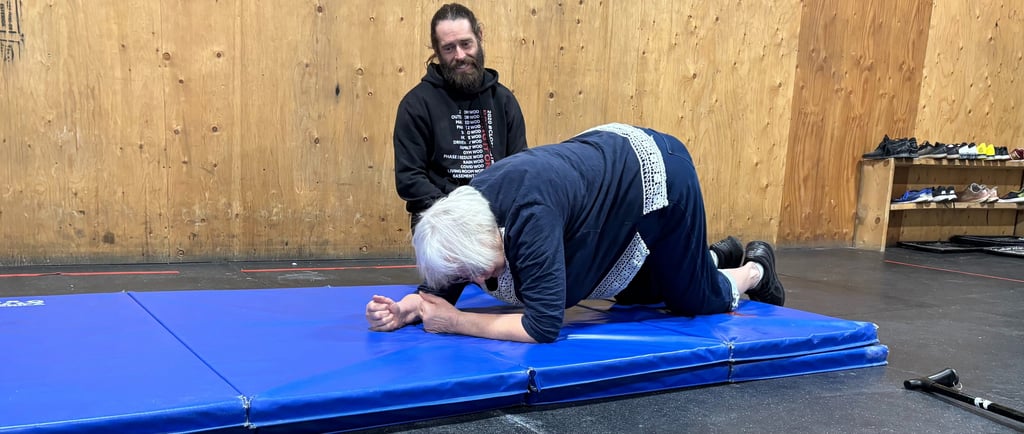
It doesn’t matter how you do it—roll, crawl, push, or use your hands. What matters is that you can.
Because the moment you can’t get off the floor on your own, your independence is already at risk.
That’s where burpees—or more accurately, burpee patterns—come in.
Why Burpees Matter
Burpees aren’t a gym trick.
They’re practice for one of the most important human abilities:
Getting down to the ground and getting back up safely.
Falls are one of the leading causes of loss of independence as we age. And it’s not always the fall itself that changes everything—it’s the inability to recover from it.
Burpees train exactly that skill.
Not fast.
Not explosive.
Not for show.
But controlled, confident transitions between standing and the floor.
Burpees = Independence
We don’t train burpees to burn calories or chase aesthetics.
We train them so you can:
Get down on the floor to play with grandkids
Get back up after a stumble or fall
Stay calm and capable instead of panicked and helpless
Losing the ability to get off the floor is often one of the earliest signs that outside help will soon be needed.
Burpees help push that moment way down the road.
This Isn’t About Muscles — It’s About Function
We’re not interested in sculpting abs or isolating muscles.
We care about capacity.
Practicing burpee-style movements improves:
Controlled lowering to the ground
Pressing strength to push yourself up
Balance and coordination
Confidence under stress
That’s not “fitness.”
That’s fall prevention.
And fall prevention is life preservation.
Start Where You Are
If the word burpee makes you nervous, good news—you don’t need to jump, move fast, or look pretty.
You just need to practice the pattern.
Here are safe, effective ways to start:
Elevated get-downs and get-ups
Use a couch, bench, or stacked mats to reduce the distance to the floor.Get-up practice
Lie down and stand up slowly and deliberately. No rush. No pressure.Segmented reps
Practice one part at a time—getting down today, getting up tomorrow.
Every repetition builds strength.
Every repetition builds confidence.
Every repetition builds freedom.
Burpees Are a Baseline, Not a Punishment
In our approach to training independence, movements like burpees (or scaled versions of them) matter because they measure what actually counts:
Can you move through life without help?
If you can get down and back up under your own power, you’re far less likely to fear falls—and far more likely to recover from them.
And if you can’t yet?
That’s not a failure.
That’s a starting point.
The Bottom Line
If you can practice getting off the floor, you can practice staying independent.
Burpees aren’t about toughness.
They’re about preparedness.
Train the skill.
Protect your freedom.
Stay capable for life.
Because the goal isn’t to be fit.
The goal is to keep living on your own terms.